
There is a conversation that has become familiar to advisors working with the very wealthy. The principal inheritor, often second- or third-generation, somewhere between forty and sixty-five, sits down with the team to talk about purpose. They speak about climate, about inequality, about the origins of the family money, about wanting their wealth to do something other than continue to grow. The advisors listen. The chief investment officer takes notes. There are follow-up sessions. A values audit is commissioned. The philanthropy budget is expanded.
And then, with admirable efficiency, the portfolio is managed much as it was before.
The gap between what wealth-holding families say they want their fortunes to do and what their fortunes actually do is now extensively documented. Since 2018, Dr Bridget Kustin, an economic anthropologist at Oxford’s Saïd Business School, has interviewed family offices across twelve countries. Her interviewees skew toward families who describe themselves as values-driven and impact-curious, a selection bias she readily acknowledges. Even so, the finding is stark. Almost none of these family offices invest the bulk of their portfolios in line with what the family publicly says it cares about. Falko Paetzold, who leads the Centre for Sustainable FInance and Private Wealth, has traced a similar gap between intention and action, identifying the role of advisers and institutional structures in preventing that interest from translating into investment decisions.
The pattern persists, Kustin’s work suggests, even in offices where the principal has spent years working on questions of purpose. The default mode is profit maximisation, with impact treated as a small carve-out at the edge of the portfolio. The values exercise produces a charter. The charter is filed. The portfolio is rebalanced. Vanishingly little, in the end, actually changes. This is not, by and large, the inheritors’ fault. It is the result of a structural mismatch between the offices they have inherited and the ambitions they hold.
“Almost none of these family offices invest the bulk of their portfolios in line with what the family publicly says it cares about.”
A machine built for one purpose
The single family office, as it has evolved over the past century, is an extraordinarily sophisticated machine built for one purpose: to preserve and grow a fortune across generations. Its architecture reflects that purpose at every level.
All family offices are different, molded by generations of wealth holders and the ideals of the time, but the conventional architecture documented by family-office scholars such as Kirby Rosplock reveals a recognisable structural pattern. At the top may sit a family council, supported by a family constitution that codifies values and decision rights. Beneath this, a board of directors may provide fiduciary oversight. Below the board, a chief executive may lead a small executive team: chief investment officer, chief financial officer, sometimes a chief operating officer and general counsel, supported by specialists in tax, estate planning, philanthropy, risk and lifestyle and beyond them an outer ring of external advisors: private banks, investment managers and law firms.
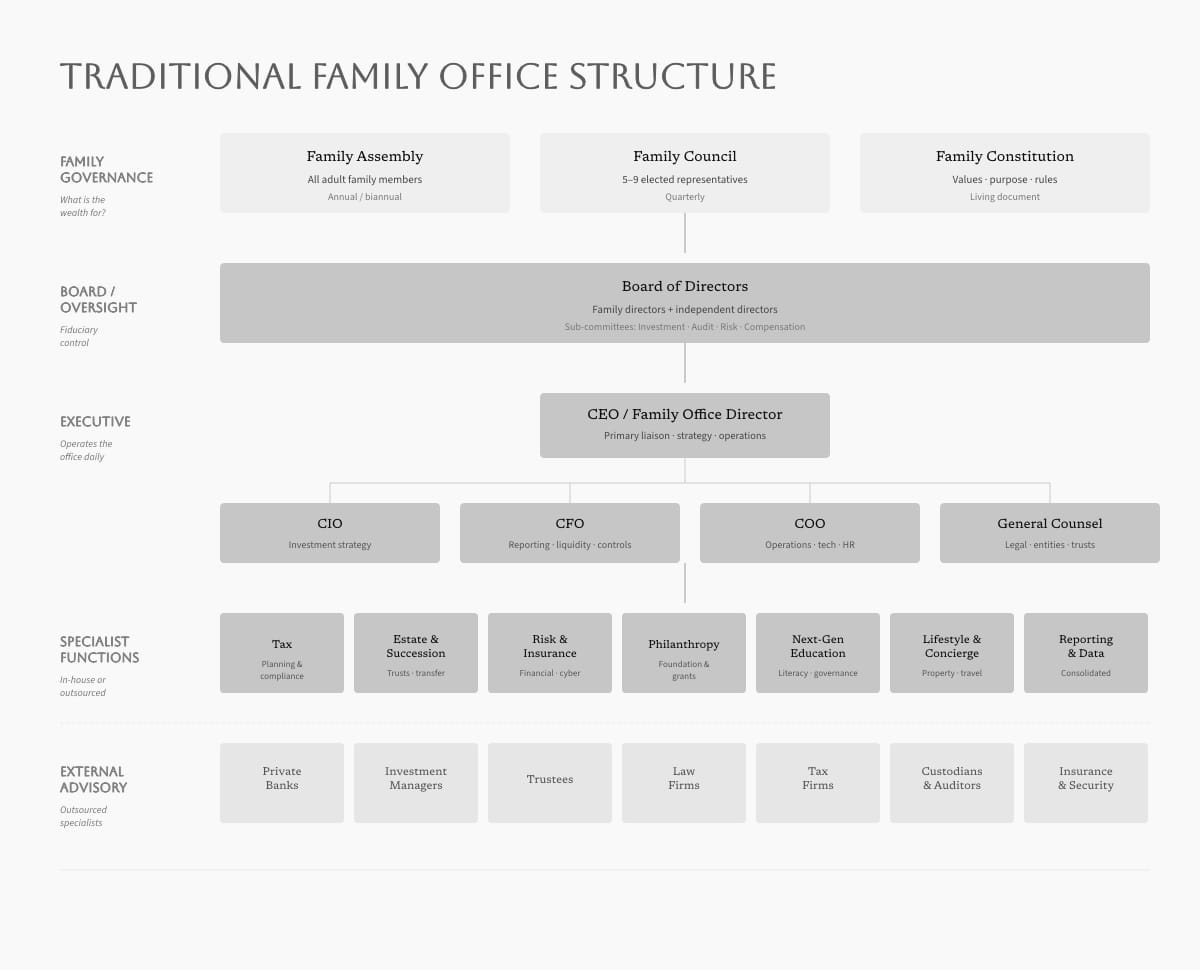
Every node in this structure is calibrated, explicitly or implicitly, to a single test: does this preserve and grow the family’s wealth? The investment function pursues risk-adjusted returns. The tax function pursues legitimate minimisation. The legal function structures entities for control and intergenerational transfer. The estate function eases the friction of inheritance. The philanthropy function, where it exists, is typically a ring-fenced budget, deployed through a foundation that runs parallel to, and is rigorously prevented from disturbing, the main portfolio.
For most of the twentieth century, this worked, in the sense that the implicit social contract held: families created wealth, the wealth created jobs, taxes and selective philanthropy followed. Whether that contract was ever as benign as advertised is debated. What is no longer debated is that a growing share of today’s wealth holders are refusing those terms.
The cohort coming of age
Right now, several things are in flux which will drive a radical revaluation of the role and functioning of the private office. The scale of inherited wealth has grown dramatically: the Great Wealth Transfer. Inheritors are older (the average age inheritors receive their wealth has shifted from 25 in the 1920s to 65 today), more politically literate and more globally connected than the cohort the industry was built to serve.
A new generation of advisers and wealth-management firms is beginning to respond. In London, Stephanie Brobbey, a former private wealth lawyer in the City, founded the Good Ancestor Movement in 2021 as an advisory firm dedicated to wealth redistribution rather than accumulation. In the United States, Chordata Capital, founded by Tiffany Brown and Kate Poole, describes itself as an anticapitalist wealth-management firm, supporting clients to redistribute wealth and move investments from Wall Street into community-controlled funds centred on racial and economic justice. Candide Group, founded by Morgan Simon and Aner Ben-Ami, works within the regulated investment industry, advising families and foundations seeking to direct their portfolios towards social justice and the construction of a new economy.
These firms differ in their methods and politics, but share a willingness to ask questions that conventional wealth advice has tended to avoid. Questions around Western imperialism, the architecture of reparations and the workings of tax policies. The conversation, in other words, is not about how to give more efficiently. It is about what wealth is for in the first place.
Some families are also rebuilding the machinery from within. In Australia, the private investment company Tripple combines investing and grant-making through a 100 per cent impact portfolio. In Hong Kong, Annie Chen’s RS Group has brought philanthropy and impact investing together within the same family-office strategy, while helping to build the wider sustainable-finance field in Asia. In Belgium, The Nest, the family office founded by entrepreneur Els Thermote, breaks with the classic "preserve and grow" model, directing its capital instead into regenerative agriculture and food-system change. These are not identical models but each represents an attempt to move values from a statement at the edge of the office into the structure and deployment of the portfolio.
A similar reframing is visible at the institutional level. The Chorus Foundation, established as a vehicle through which its founder could redistribute his wealth, completed its spend-down in 2023, transferring its remaining resources to frontline groups and community infrastructure working towards a just transition. That same year, the £130 million Lankelly Chase Foundation announced that, after sixty years as a grant-making foundation, it would redistribute its entire endowment and dissolve within five years. The trustees explained the decision, describing traditional philanthropy as “a function of colonial capitalism” that could no longer credibly meet the scale of the crises it sought to address.
For wealth holders watching from inside private offices, these experiments function as a kind of radical permission slip. They demonstrate that structural commitment, and not merely rhetoric, is possible.
Where the office obstructs
Research by Kustin, Paetzold and others surfaces a consistent problem: the wealth advisory industry can itself become a principal brake on these ambitions. The structures and incentives that make a family office efficient at preserving wealth are precisely the structures and incentives that make it slow, expensive or impossible to redeploy that wealth towards other goals. Sarah Teacher’s research for the Impact Investing Institute reaches a similar conclusion, finding that while some investment professionals are developing new capabilities, others have both outdated assumptions and a material incentive to maintain the status quo.
Investment advisors are typically compensated as a percentage of assets under management, which means their incomes shrink the moment a family begins to redistribute. Trust structures, optimised for asset protection and tax efficiency, often make it administratively complex to move large amounts of capital quickly or restrict capital to only a few uses. Fiduciary duty, in its narrowest reading, is routinely invoked to argue that trustees are legally obliged to prioritise financial return.
Although Peter Vogel and colleagues at IMD describe “total family wealth” as encompassing human, social, intellectual, reputational, cultural and spiritual capital alongside financial assets, these other forms of wealth rarely shape the office’s investment architecture. The idea of immaterial wealth, be that a family’s energy, skills, or network (as Marine discusses here) remains largely outside its operating logic.
Even the vocabulary is shaped by the old purpose. Wealth preservation. Generational transfer. Estate efficiency. These are the dialects of accumulation. An office staffed entirely with fluent speakers of this dialect will struggle, as this body of work suggests, to imagine, let alone execute, a strategy of impact, generosity, repair or redistribution.
Marjorie Kelly’s work on ownership design makes a related point: ownership is not a neutral legal condition. Its purpose, governance, capital and networks determine what a structure is designed to produce. Building on Kelly’s work, Kate Raworth and the Doughnut Economics Action Lab argue that an organisation’s purpose, networks, governance, ownership and finance together determine what it is capable of becoming. Changing its stated purpose without changing this deeper design will rarely change what it produces.
To own is a verb. The structure does whatever the owner has the courage to make it do.
There is, Kustin has noted, a quieter point underneath all this. “To own is to possess power,” she writes, in a toolkit developed at Oxford University for family-business owners. There is no such thing as a neutral structure. There is no such thing as just being a shareholder, just being a beneficiary, or just sitting at the head of a wealth structure that someone else administers. To own is a verb. The structure does whatever the owner has the courage to make it do, or by default, whatever the structure was built to do.
What a reimagined office might look like
The interesting question, increasingly raised at gatherings of progressive wealth holders and their advisors, is what an office built for the new purpose would actually look like. It is also a question being explored through emerging family-office models and services. Kinido approaches the office through what it calls family-centric systems design, beginning with the family’s relationships, purpose and wider ecology rather than its portfolio alone. PFC, a single family office in Milan, is integrating philanthropy and investment through a Spectrum of Capital, while changing its governance and building impact considerations across the portfolio. You can read more about PFC’s journey here. It is not the old office with an impact sleeve attached. It is a different machine, calibrated to a different test: does this serve the ambitions of the steward?
A reimagined office has several distinctive features. Its governing document is an Impact Charter rather than a family constitution. Its board includes trustees with lived experience of the issues the office seeks to address, alongside family and independent directors. Its investment function is renamed and rewired: a Director of Impact replaces the Chief Investment Officer, with a mandate to activate the entire portfolio toward impact in the world rather than preserving wealth. Compensation is restructured to flat fees or impact-linked metrics, breaking the perverse incentive to grow assets under management. A named inner-work practice — a steward’s companion, drawing variously on family systems therapy, somatic work and political or philosophical enquiry — sits in the governance layer as an ongoing seat rather than a discreet therapeutic referral.
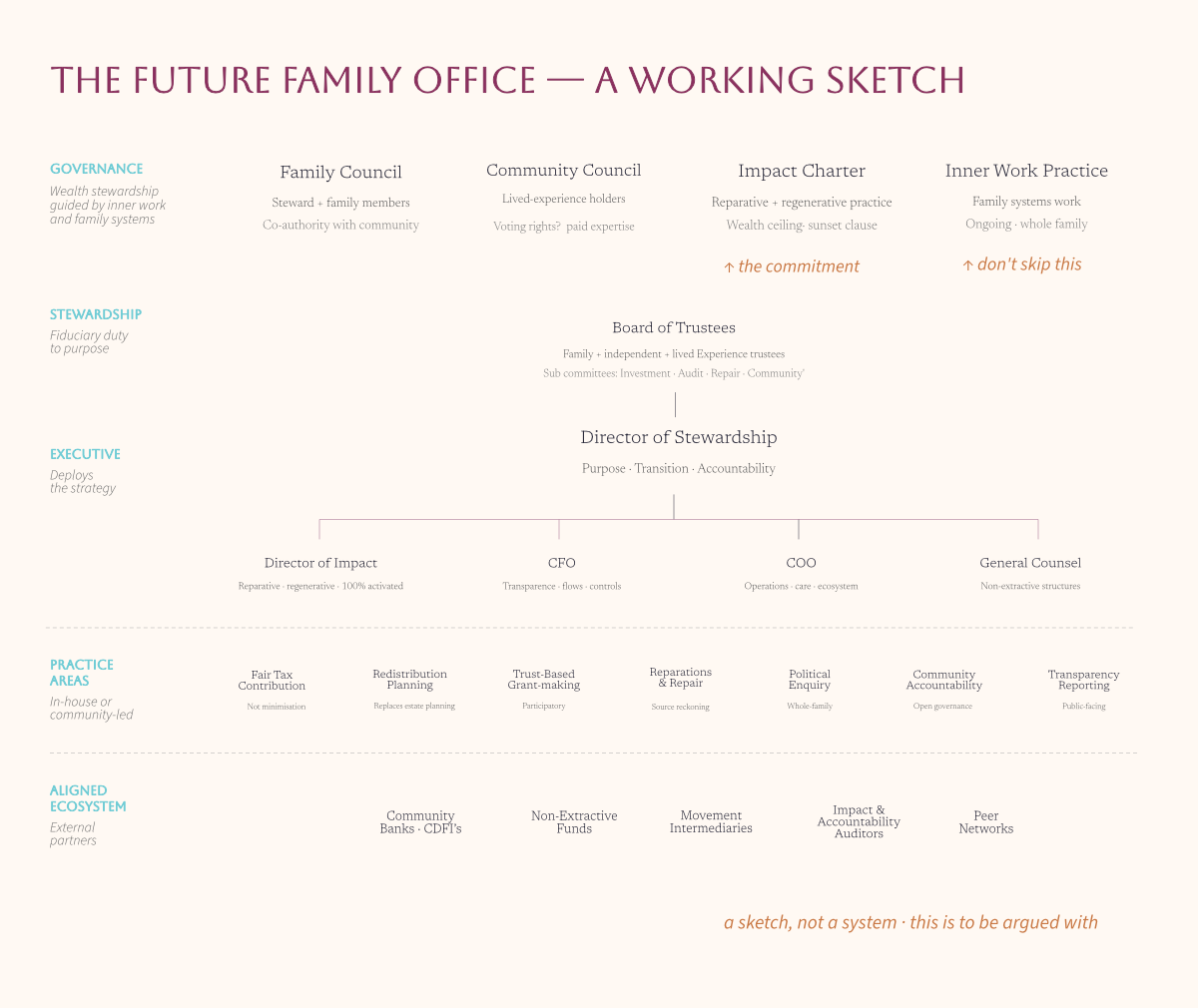
These are not features of a single, established model. Kinido’s family-centric approach and PFC’s integration of investment, philanthropy and family governance suggest different pathways into the work. What they share is an understanding that changing the investments without changing the relationships, capabilities and structures surrounding them will only take a family so far.
The office is also networked into a different ecosystem: community development financial institutions, regenerative and integrated-capital organisations such as the Triodos Regenerative Money Centre; non-extractive, community-controlled funds such as the US-based Seed Commons and others surfaced through the Transformative 25; and movement-aligned organisations and vehicles such as Solidaire Network, Thousand Currents’ Buen Vivir Fund, Justice Funders’ Just Transition Integrated Capital Fund and the Good Ancestor Movement’s Catalytic Collective. Together, these organisations offer instruments ranging from grants and guarantees to patient loans, recoverable grants, blended finance and other forms of capital structured around the needs of the work.
None of this is yet fully built. The institutions, the talent pipeline and the precedents are nascent. But the demand is not hypothetical. Kustin’s research demonstrates with anthropological precision that a growing cohort of wealth holders are looking for structures and services that the conventional industry is not yet equipped to provide. The challenge is to prevent the existing structures from neutralising their ambitions.
A once in a generation opportunity
The Great Wealth Transfer is the largest in human history. Its arc could be toward concentration or redistribution, perpetuation or repair. As things stand, it will be shaped less by the intentions of the wealth holders than by the institutions that hold their capital. We have to ask ourselves: are we content to let this happen?
If the family-office industry continues to optimise for preservation, those institutions will quietly absorb a generation’s worth of ambition into a slightly more polished version of the same machine. If, instead, the practitioners and academics now sketching alternatives find traction, and if wealth holders themselves are willing to commit structurally rather than rhetorically, something quite different becomes possible.