
Money is only one of the resources I have access to.
The very first ROOM event I ever ran, I wanted to map out what was happening in my brain when I was investing. ROOM is a community of women investors that I started in 2022, it has become a place where we can talk openly about money together and share our experiences. I had to understand for myself how I was navigating managing my own capital before I could explain it to others.
I had many blocks and fears, like a lot of people in my situation, and I had worked around them (they still exist) using two techniques. First, I put all of my material wealth in a spreadsheet to calculate the totality of what I owned personally and in real numbers. I then subtracted all of my current needs and an estimate of what I would need for the future (until my death in 45 years). This gave me a concrete amount of money that I could allocate without having to compromise on any of my material needs or wants. The second technique consisted of considering the money in a wider scope of everything I had in terms of resources; my polycapital. This reframing made moving the financial capital a lot less terrifying.
Rather than only considering the money, I started thinking about all the resources I had. Rather than looking at only the financial gain of an investment, I started thinking in terms of resources gained. For example, when I give to a charity, I’m not losing money, I’m gaining in social awareness, in stories to tell, in moral superiority. In short, it gives something else back.
It was only by entering all this data into a pretty Powerpoint deck that I could clarify the reasons and motivations behind my actions. It brought me peace. For the previous 10 years I had not been actively managing my financial capital and my “paralysis” was linked to the belief that I was “only” going to lose money. Drawing up a table of what I was going to gain in joy, in connections, in intelligence made taking action so much easier.
Today I’m more and more convinced that there’s no point agonising over choices, you just make decisions and throw yourself entirely in the chosen direction. I prefer remorse over regret.
"When you dare, you often make mistakes. When you don't dare, you always make mistakes." Romain Rolland
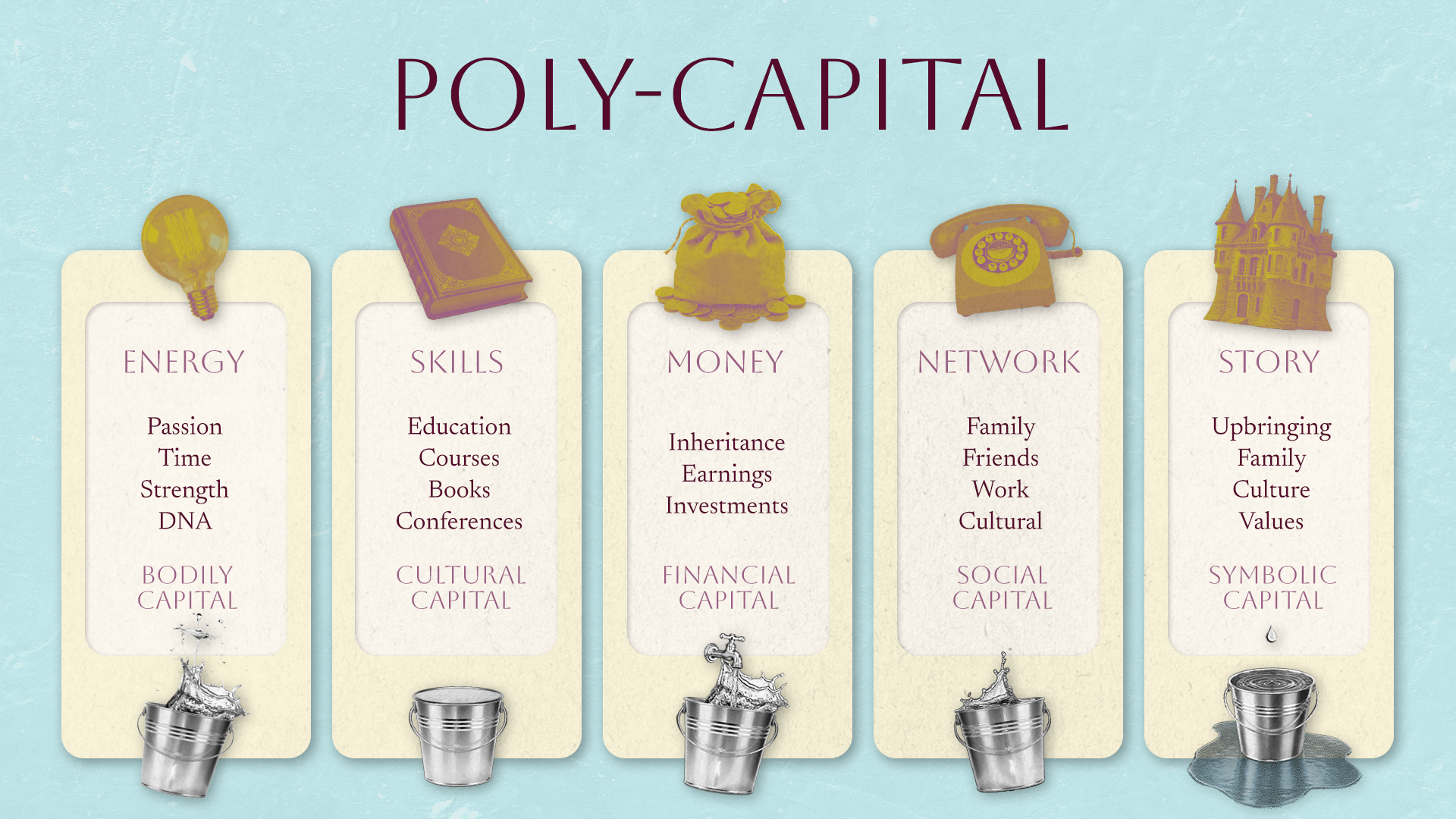
Here are the 5 resources that I own or have access to and that I gain or trade off when making any decision.
1. Energy
For me, I see this as what brings me pleasure, the time I want to give to things. It’s obvious that our DNA plays a role; it’s easier to drive a car if you can see well, it’s easier to raise funds for your company if you’re a handsome white male (according to sociological research). What drains energy or gives energy is different for everyone. I just like to be aware of it in what I do. For example, being in large groups of people takes energy from me but listening to a new theory or way of thinking gives me energy, and sometimes you can only discover those things by being in a large group.
When I show up fully present and engaged in a conversation, even when I’m tired, I almost always leave with more energy than I arrived with. Giving attention generates attention back. Enthusiasm is contagious.
2. Skills
I like to see this as everything we pick up intellectually, what we can absorb in terms of knowledge and learning. It covers diplomas as much as the ability to fold paper planes. And if you start listing them, you notice that acquiring skills always produces more skills.
I had completely underestimated how much sharing my skills would bring back to me: people's reactions, introductions to books, invitations into other rooms, where I'd end up learning far more than I'd taught, oversaturating my brain in the best way.
3. Money
This is the easiest one to understand — it fits neatly into a spreadsheet, and it's obvious how directly convertible it is.
Investing, placing, saving, we’re constantly reminded that you make money with money. And it’s true, but the example I find most striking is much simpler: paying for a good accountant. You spend money, and in return you get more money back: through tax optimisation, better structures and avoiding mistakes. You offered money, you received money. It’s the most literal trade there is.
4. Network
“You Are the Average of the Five People You Spend the Most Time With” — Jim Rohn. This resource, the network, is very visible today through social media, your links on LinkedIn, your followers on instagram, the size of your rolodex. But it’s so much more than that. You build it by going out into the world and doing things; you meet people, this widens your circle and the more you move around, the wider the connections spread.
Today, there are endless opportunities for networking, whether in a professional environment, a PTA meeting or a sewing circle. We are continuously building our network. Small or large. It’s clear that the more people you meet, the more people you meet.
5. Story
Alain de Botton says that a child who grows up around people of great renown quickly understands that these people are just human and so they are less impressed by fame. They’ve seen these people grumble, get sick, laugh at crude jokes, just like everyone else (or not). They don’t put them on a pedestal. My story, the rules I learned at home, the codes of conduct, the values, the cultural adaptations, all of this allows me to move easily through different environments. I also inherited a family history that gives me things to tell, a useful backstory until I create my own. The stories told to us allow us to write stories of our own. Having a funny, joyful, or divisive family gives me so much to share, it can make the search for identity so much easier (at first).
Every time I share a story from my family history, even a complicated or uncomfortable one, someone in the room opens up and shares one of theirs. Stories unlock stories. The more I offer mine, the richer my collection becomes. It’s probably the most generous of all the exchanges.
The real genius: trading across capitals
We’re made to believe these capitals live in silos, especially the money bucket. I’ve deliberately only given examples above of exchanging one type of capital to acquire that same type, but that’s a limited view. All the genius lies in the exchange and barter of one capital for another.
In reality, every significant decision involves trading several resources at once and receiving several others in return. Take a concrete example: I decide to co-invest in an early-stage company with someone I admire but don’t know well. I spend money (economic capital) and time and attention (energy). What do I get back? A close relationship built through shared risk (network), a front-row seat to how a founder thinks and operates (skills), a story worth telling, whether it succeeds or fails (story), and, if the venture is a success, more money too. One decision, five capitals in motion simultaneously. That’s where the real return lives.
Bourdieu explains the transfer of economic capital to cultural capital when you pay for training or the reverse. When economic capital grows (through professional success or inheritance) it pulls social capital up with it; people tend to gravitate toward wealth be it bankers or peers. The capacity to influence is greater with greater skills and network as well as money. There are so many transfers that are possible. I find it most interesting when I manage to use and juggle across all five of my resources. Sometimes this just means taking stock of the cross exchange (happy side effects), not intentionally initiating it.
In my mind it looks like buckets filling up or emptying out depending on decisions and life events. A death empties our energy bucket but fills (in the case of families with intergenerational wealth) the money, network and story buckets. Death also fills the skills bucket; navigating estate administration and sorting through a dead person’s belongings blows up your resourcefulness, your patience, your capacity to get through incredibly tedious things at a very emotionally rough time.
Someone very rightly told me that not managing, using and enjoying your financial capital “because you received it from your parents” (and therefore it doesn’t really belong to you) would be like not using your intelligence (also received from your parents through DNA and socialisation).
If we put money in its rightful place, one resource among many, simply a resource you can tap into and trade for other things, the whole exercise becomes so much more joyful. The uncertainty and pressure of financial outcomes is softened by all the other things gained or shared along the way.
We can ultimately talk about two broad categories: material and immaterial capital. When it comes to wealth management, there are banks, tax advisors, structures, foundations, but to welcome, manage and understand our immaterial capitals, there is very little out there. That gap is what keeps pulling me back to this work: all of the resources I share or reap feed into each other.
Years on from that first ROOM event, I still do a version of what I did that day: I lay out my buckets and ask which ones a decision will fill and which it will drain. The layout was only ever the beginning. What actually calmed me was realising money was never the whole picture, just one element among five (or more), and rarely the most important one. It demystified what I was actually set out to gain or lose every time I “used” my financial capital, and that's what pulled me out of a scarcity mindset. That's the map I wish someone had handed me at the start. It's the one I now try to hand to the women who come to ROOM: not a way to count what you have, but a way to see all of it, and to move it with joy and a little less fear.